ISO 27001:2022: Step-by-Step Implementation Guide
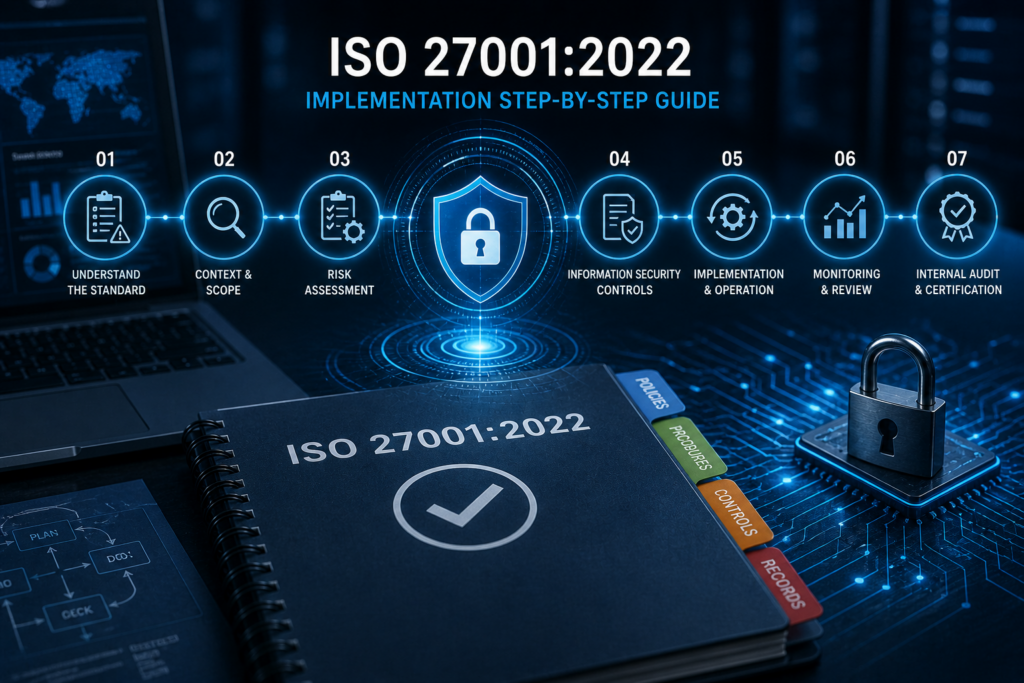
How to implement an effective Information Security Management System
In a threat landscape that evolves constantly, protecting information is no longer optional. Organizations seeking resilience and trust must adopt structured frameworks that enable continuous risk management.
ISO 27001:2022 has become the international standard for information security management. However, many organizations fail not due to lack of intent, but because they lack a clear implementation strategy.
Achieving ISO 27001 compliance is not just about certification, but about building a robust system that protects critical business assets.
The Problem: Incomplete or audit-driven implementations
Many organizations approach ISO 27001 as a documentation exercise.
This leads to:
- Controls implemented only on paper
- Lack of alignment with real risks
- Processes that are not followed in practice
- Difficulty maintaining certification
The result is an organization that is “compliant” but still vulnerable.
The Solution: Structured ISO 27001:2022 Implementation
Step 1: Define the ISMS scope
The first step is to determine which assets, processes, and areas will be included in the Information Security Management System (ISMS).
A poorly defined scope can either exclude critical assets or make the project unnecessarily complex.
Step 2: Risk identification and assessment
ISO 27001 is built around risk management.
Organizations must identify threats, vulnerabilities, and potential impacts.
This allows prioritization of controls based on real risk.
Step 3: Control selection and implementation
Based on the risk assessment, controls from Annex A of ISO 27001:2022 are selected.
These controls cover areas such as:
- Access control
- Information security policies
- Data protection
- Incident management
The key is to implement effective controls, not just document them.
Step 4: Documentation and policies
ISO 27001 requires structured documentation to support the ISMS.
This includes:
- Information security policy
- Operational procedures
- Incident response plans
Documentation must be clear, practical, and aligned with real operations.
Step 5: Awareness and training
The human factor plays a critical role in security.
Training employees ensures policies are followed and reduces the risk of human error or social engineering attacks.
Step 6: Internal audit and continuous improvement
Before certification, internal audits must be conducted to identify gaps and validate compliance.
ISO 27001 is based on continuous improvement, not a one-time implementation.
Step 7: Certification and maintenance
Once the ISMS is implemented, the organization can undergo external audits to obtain certification.
However, the real challenge is maintaining and continuously improving the system.
Benefits of ISO 27001:2022 implementation
- Effective protection of sensitive information
- Reduced cybersecurity risks
- Compliance with international standards
- Increased customer trust
- Stronger business reputation
Conclusion: More than compliance, a security strategy
ISO 27001:2022 should not be seen as a requirement, but as a competitive advantage.
Organizations that properly implement an ISMS go beyond compliance and build real resilience against cyber threats.
Adopting a structured approach aligned with GRC transforms security into a continuous and strategic business function.
👉 IMPLEMENT ISO 27001 WITH A STRATEGIC APPROACH
🌎 GLOBAL ATTENTION & COVERAGE
📞 Phone / WhatsApp:
- 🇲🇽 MX: +52 1 55 5550 5537
- 🇺🇸 USA: +1 (918) 540-9341
📧 Email Support & Sales:
🌐 We provide immediate attention, strategic consulting, and deployment of Security Compliance Specialists and Cybersecurity Experts across the entire Americas, ensuring business continuity in the main markets of:
- 🇺🇸 Estados Unidos: Miami, Houston, New York, San Francisco, Los Angeles, entre otras.
- 🇲🇽 México: México City (CDMX), Monterrey, Guadalajara, Querétaro, Tijuana (Cobertura Nacional).
- 🇬🇹 Guatemala: Guatemala City, Quetzaltenango, Escuintla, Antigua Guatemala (Cobertura Nacional).
🌎 Latinoamérica: Bogota, Medellin, Lima, Santiago de Chile, Buenos Aires, Sao Paulo, Panama City, serving the entire region.
Tags:
#Cybersecurity #ISO27001 #ISMS #InformationSecurity #GRC #Compliance #RiskManagement #CybersecurityStrategy