Incident Response Plan: The First 60 Minutes
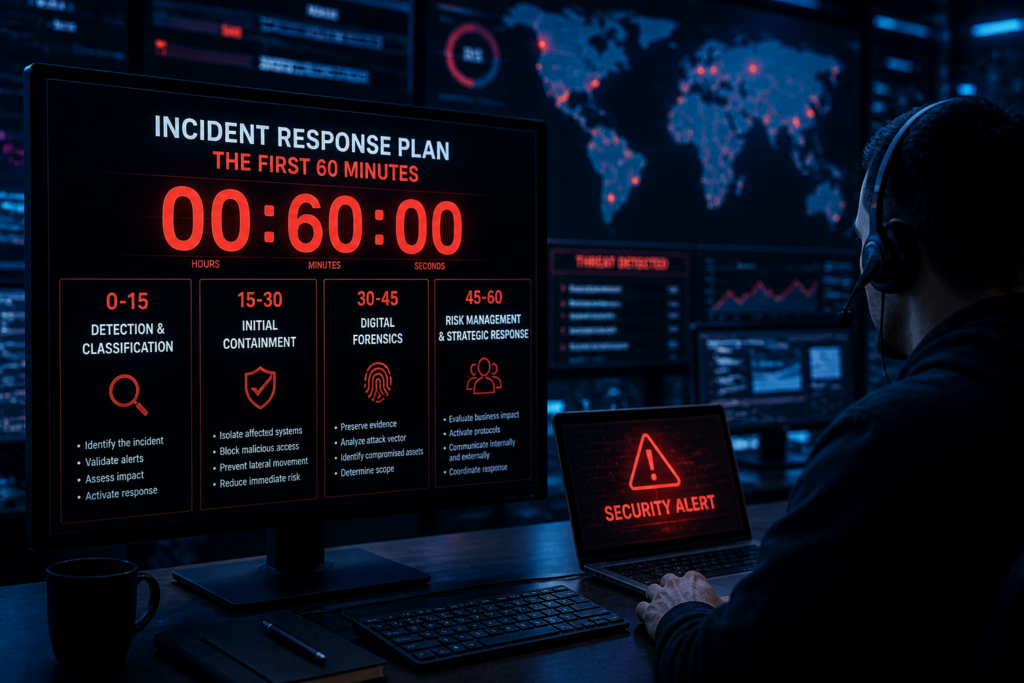
In cybersecurity, time is the most critical factor. When an incident occurs, the first 60 minutes determine whether the threat will be contained or escalate into a major breach.
Many organizations invest in prevention but fail in response. The issue is not the lack of tools, but the absence of a structured Incident Response (IR) plan that can be executed in real time.
Attackers do not wait. Within minutes, they can escalate privileges, move laterally, and compromise critical systems.
The difference between control and crisis lies in how you act during the first hour.
The Problem: Lack of structured response
Most organizations react in an improvised manner when an incident occurs.
This leads to:
- Delays in detection and containment
- Lack of coordination between teams
- Loss of critical evidence
- Increased operational and financial impact
Without a clear plan, every minute works in favor of the attacker.
The Solution: Response strategy in the first 60 minutes
Minute 0–15: Detection and classification
The first step is to confirm the incident.
This requires visibility, monitoring, and clear criteria to identify real threats and activate response protocols without delay.
Minute 15–30: Initial containment
Once identified, the objective is to limit the damage.
This includes isolating affected systems, blocking compromised access, and preventing lateral movement within the network.
Minute 30–45: Digital forensic analysis
Alongside containment, preserving evidence is critical.
Digital forensics allows organizations to understand how the attack occurred, which systems were compromised, and the full scope of the incident.
Minute 45–60: Risk management and strategic response (GRC + IR)
At this stage, the organization must take full control of the incident.
This includes:
- Assessing business impact
- Activating compliance protocols
- Managing internal and external communication
- Coordinating incident response (IR) actions
Benefits of acting within the first hour
- Significant reduction in attack impact
- Rapid threat containment
- Preservation of critical evidence
- Regulatory compliance
- Improved control and strategic decision-making
Conclusion: The first hour defines resilience
In cybersecurity, it is not a matter of if an incident will occur, but when.
Prepared organizations do not improvise, they execute.
Having an incident response plan, supported by digital forensics and a GRC-driven approach, enables fast, precise, and controlled action in critical moments.
👉 STRENGTHEN YOUR INCIDENT RESPONSE CAPABILITIES
🌎 GLOBAL ATTENTION & COVERAGE
📞 Phone / WhatsApp:
- 🇲🇽 MX: +52 1 55 5550 5537
- 🇺🇸 USA: +1 (918) 540-9341
📧 Email Support & Sales:
🌐 We provide immediate attention, strategic consulting, and deployment of Security Compliance Specialists and Cybersecurity Experts across the entire Americas, ensuring business continuity in the main markets of:
- 🇺🇸 Estados Unidos: Miami, Houston, New York, San Francisco, Los Angeles, entre otras.
- 🇲🇽 México: México City (CDMX), Monterrey, Guadalajara, Querétaro, Tijuana (Cobertura Nacional).
- 🇬🇹 Guatemala: Guatemala City, Quetzaltenango, Escuintla, Antigua Guatemala (Cobertura Nacional).
🌎 Latinoamérica: Bogota, Medellin, Lima, Santiago de Chile, Buenos Aires, Sao Paulo, Panama City, serving the entire region.
Tags:
#Cybersecurity #IncidentResponse #DigitalForensics #RiskManagement #InformationSecurity #CyberDefense