Goodbye 2025 The 5 Cybersecurity Threats That Will Define 2026
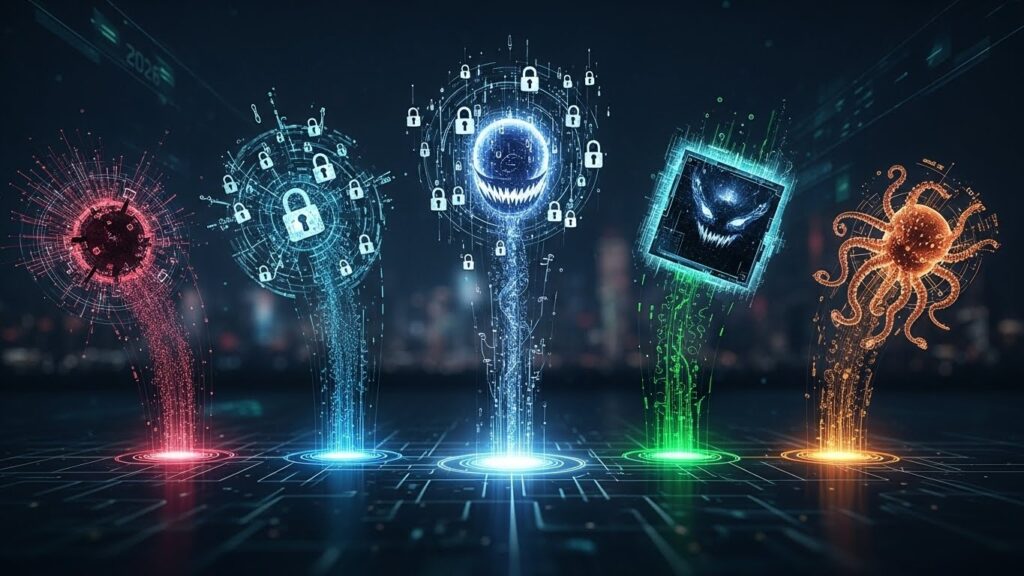
As we close this year, the boundary between innovation and risk has become thinner than ever. 2025 left us with valuable lessons about the fragility of supply chains and the power of automation. At Hacking Mode, we have analyzed attack patterns across Latin America and the USA to project the digital battlefield that awaits us.
The 2026 cybersecurity threats will not be mere evolutions of the past; they will be hyper-personalized and autonomous attacks. For businesses, the question is no longer if they will be attacked, but how fast they can recover under a modern cyber-resilience model.
A Glimpse into the Risk Horizon
The transition to 2026 demands that organizations elevate their cybersecurity services from a reactive posture to a proactive one. Artificial Intelligence, which has been our ally, has also become the primary weapon for the most sophisticated ransomware groups.
Below, we detail the five trends that will force a rewrite of corporate defense manuals.
1. Ransomware 3.0: Automated Triple Extortion
It is no longer just about encrypting data. In 2026, we will see attacks that demand payments for not revealing industrial secrets, for not attacking direct clients, and for not saturating services with massive DDoS—all managed by AI that adjusts ransom demands in real-time based on the victim’s financial health.
2. Real-Time Identity Deepfakes
Identity fraud will scale to science-fiction levels. We expect a surge in attacks where the voice and video of executives will be spoofed in live meetings to authorize bank transfers or access to critical databases.
3. Adversarial ML (AI Model Poisoning)
As companies integrate AI into their processes, attackers will attempt to “poison” training data so that security systems learn to ignore specific attack patterns or so that corporate chatbots inadvertently reveal confidential information.
4. Software Supply Chain Attacks
The focus will shift from large corporations to their cloud service providers and specialized software vendors. A single compromise in an open-source component or a management tool can open the door to thousands of organizations simultaneously.
5. Exploitation of Industrial IoT Vulnerabilities
With the expansion of 5G and industrial automation, sensors and connected devices in factories and power plants will be primary targets for cyber-espionage and operational sabotage.
Shielding the Future with Hacking Mode
Faced with these cybersecurity trends and future threats, the response must be defense-in-depth. At Hacking Mode, our services are designed to intercept these vectors through intelligent monitoring, constant Red Teaming, and high-level compliance consulting.
2026 will be a year of great opportunity for those who secure their infrastructure today. Preparation is the only real competitive advantage in a hyper-connected world.
Conclusion
The turn of the year is the ideal time to audit our defenses. The threats of 2026 are sophisticated, but with the right strategy and expert guidance, your company can navigate this new environment with total operational confidence.
🌎 GLOBAL ATTENTION & COVERAGE
📞 Phone / WhatsApp:
- 🇲🇽 MX: +52 1 55 5550 5537
- 🇺🇸 USA: +1 (918) 540-9341
📧 Email Support & Sales:
🌐 Global Coverage & Service Locations We provide immediate attention, strategic consulting, and deployment of Security compliance specialists and cybersecurity experts across the entire Americas, especially in the main markets of:
- 🇺🇸 United States: Miami, Houston, New York, San Francisco, Los Angeles, among others.
- 🇲🇽 Mexico: Mexico City (CDMX), Monterrey, Guadalajara, Queretaro, Tijuana (Nationwide Coverage).
- 🇬🇹 Guatemala: Guatemala City, Quetzaltenango, Escuintla, Antigua Guatemala (Nationwide Coverage).
- 🌎 Latin America: Bogota, Medellin, Lima, Santiago de Chile, Buenos Aires, Sao Paulo, Panama City, serving the entire region.
Tags: #HackingMode #Cybersecurity #HackingServicios #Trends2026 #CyberThreats