Agility vs. Rigidity: Why Static Defenses Are Your Biggest Vulnerability in 2026
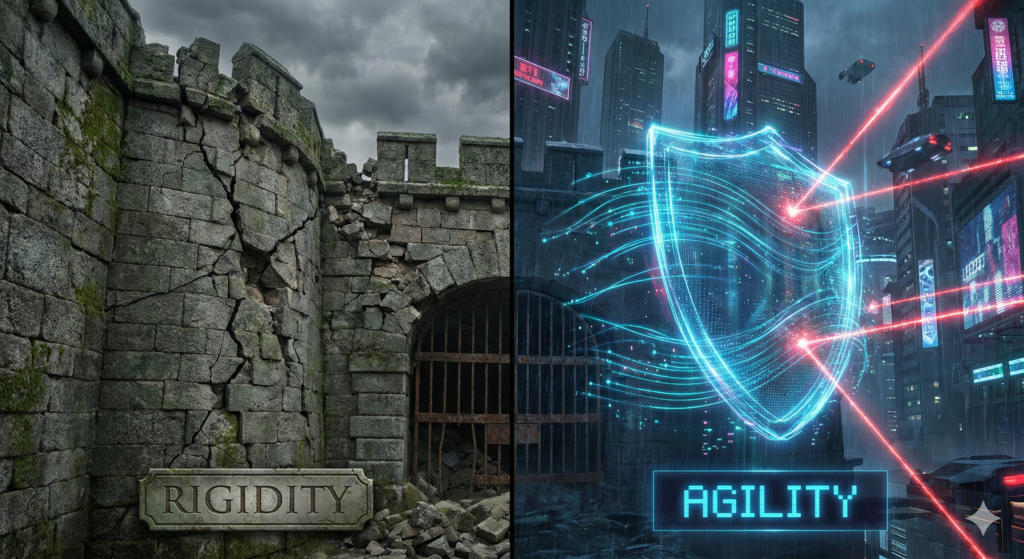
We kick off February with an uncomfortable truth: attackers are agile, but enterprises remain rigid. While a Ransomware group rewrites its code in hours to evade detection, corporations take weeks to approve a critical patch.
In 2026, “paper security” no longer protects. The gap between attack speed and corporate bureaucratic speed is where disasters happen. If your defense strategy relies on static checklists rather than real Consultancy for agility, your organization is operating with a target on its back.

The Hidden Cost of Rigidity
The traditional security model resembles building a castle: high walls, deep moat, but immovable. The problem is the enemy no longer besieges the walls; they teleport inside via stolen credentials or zero-day vulnerabilities.
Rigidity manifests when:
- You wait for the annual Audit to look for flaws.
- Security alerts are ignored due to understaffing or fatigue.
- Hardening implementation is delayed for fear of “breaking” business operations.
This slowness is lethal. Statistics indicate the average time from intrusion to lateral movement has dropped drastically. Static defense is obsolete.
The Solution: Dynamic Defense and Continuous Offense
To survive this year, we must shift from a “fortress” mindset to a “living organism” mindset. Security must be adaptive, constant, and above all, battle-tested.
1. Recurring Offensive Validation
You cannot trust a snapshot of your security taken six months ago. Agility requires iterative Pentesting. This means simulating attacks not just to meet a standard, but to measure your Blue Team’s response speed. If your systems change weekly, your stress tests should too.
2. Real-Time Visibility
Rigidity blinds. Agility illuminates. A modern SOC doesn’t just collect logs; it actively hunts threats. The ability to detect an anomaly and isolate an endpoint in minutes, without passing through three levels of bureaucratic approval, defines business continuity in the face of a massive cyberattack.
3. Vulnerability Management as a Process, Not a Project
Vulnerability Scanning must be continuous. New gaps appear daily. An agile company integrates bug fixing into its DevOps cycle, automating security where possible and prioritizing risks that actually threaten critical assets, rather than trying to patch everything without strategy.
Conclusion
“Agility vs. Rigidity Week” starts today with a call to action: break the bureaucracy before a hacker breaks your database. Security is not a final state, it is a process of continuous adaptation. At Hacking Mode, we don’t sell false senses of security; we offer the capability to resist, respond, and recover at the speed of today’s market.
👉 SCHEDULE YOUR RESILIENCE TEST NOW
🌎 GLOBAL ATTENTION & COVERAGE
📞 Phone / WhatsApp:
- 🇲🇽 MX: +52 1 55 5550 5537
- 🇺🇸 USA: +1 (918) 540-9341
📧 Email Support & Sales:
🌐 Global Coverage & Service Locations We provide immediate attention, strategic consulting, and deployment of Security Compliance Specialists and Cybersecurity Experts across the entire Americas, ensuring business continuity in the main markets of:
- 🇺🇸 United States: Miami, Houston, New York, San Francisco, Los Angeles, among others.
- 🇲🇽 Mexico: Mexico City (CDMX), Monterrey, Guadalajara, Queretaro, Tijuana (Nationwide Coverage).
- 🇬🇹 Guatemala: Guatemala City, Quetzaltenango, Escuintla, Antigua Guatemala (Nationwide Coverage).
- 🌎 Latin America: Bogota, Medellin, Lima, Santiago de Chile, Buenos Aires, Sao Paulo, Panama City, serving the entire region.
Tags: #HackingMode #Cybersecurity #SecurityCompliance #HackingRED #Pentesting2026