Endpoint Protection (EDR/XDR) Explained
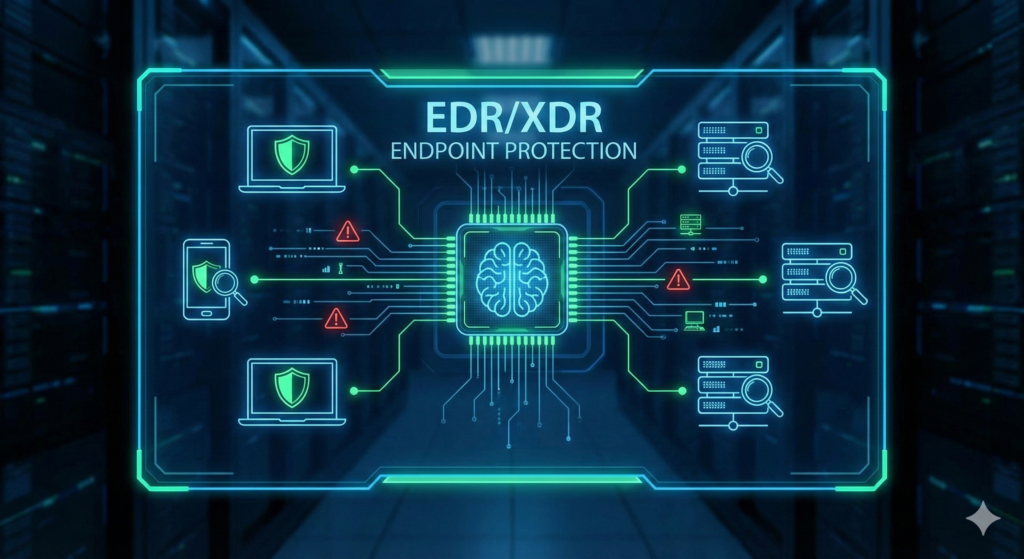
In the 2026 cybersecurity landscape, the “alphabet soup” of defense technologies (EDR, NDR, XDR, MDR) has become a barrier bigger than the budget itself. IT decision-makers face analysis paralysis, bombarded by vendors promising their tool is the “silver bullet.”
Understanding the edr vs xdr meaning is not an academic exercise; it is the difference between seeing an attack on a single laptop or understanding how a hacker moved from email to your database server. Technical complexity should not be an excuse for insecurity.
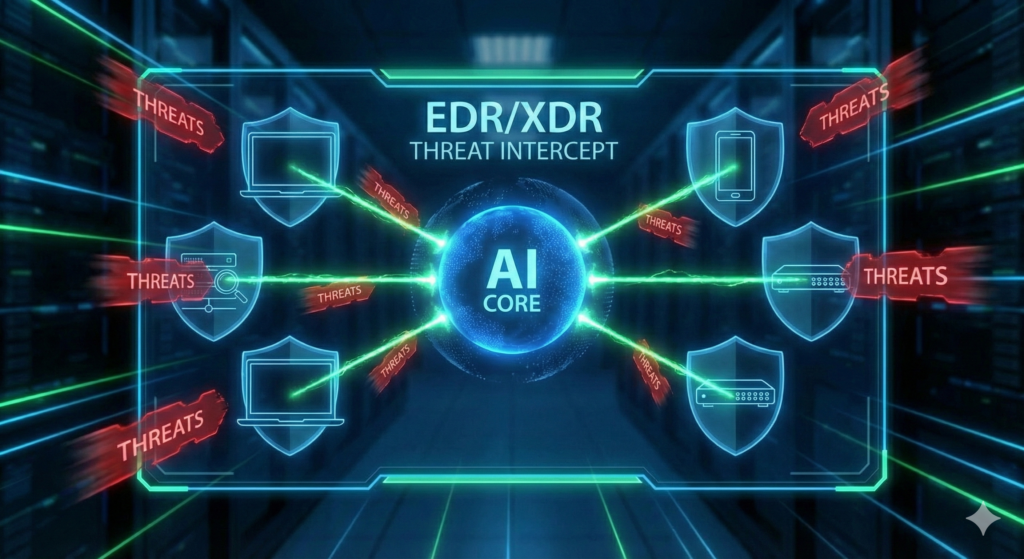
The Problem: Blindness by Silos
The traditional approach of installing an antivirus and “hoping for the best” died years ago. The current problem is having disconnected tools. An EDR might alert you to malware on a PC, but it won’t tell you that the file entered through a misconfigured firewall. This fragmented view generates alert fatigue: your team receives so many disconnected warnings that they end up ignoring the real attack until it is too late (Ransomware).
The Solution: Unified Visibility
To defend yourself today, you need correlation, not just detection. Here we break down the differences and how to integrate them.
1. EDR (Endpoint Detection and Response)
Think of EDR as an advanced CCTV camera installed inside each device (laptop, server). It records what happens inside the endpoint. It is vital for detecting behavioral anomalies, such as a PowerShell script running in the background. However, its vision ends where the device ends.
2. XDR (Extended Detection and Response)
XDR breaks the silos. It evolves the previous concept by connecting endpoint data with the network, cloud, and email. If a user downloads a malicious file, XDR not only blocks the file on the PC but can also order the Firewall to block the source IP and search the entire network for anyone else who received that email. It is an orchestrated and automated response.
3. The Human Component: SOC & Threat Hunting
Having a scalpel doesn’t make you a surgeon. EDR/XDR tools generate data, but they require expert analysts to interpret it and act. A SOC (Security Operations Center) service ensures that expert human eyes are watching those consoles 24/7, performing proactive Threat Hunting to find threats that automated tools missed.
Conclusion
Technology alone will not save you. The key to resilience in 2026 is the combination of extended visibility (XDR) with human intelligence (SOC) to manage complexity. Do not buy tools just to accumulate them; implement capabilities to respond.
Stop trying to decipher alerts at 3:00 AM. Delegate the surveillance to those who live to hunt threats.
👉 LET OUR EXPERTS WATCH YOUR NETWORK 24/7
🌎 GLOBAL ATTENTION & COVERAGE
📞 Phone / WhatsApp:
- 🇲🇽 MX: +52 1 55 5550 5537
- 🇺🇸 USA: +1 (918) 540-9341
📧 Email Support & Sales:
🌐 Global Coverage & Service Locations We provide immediate attention, strategic consulting, and deployment of Security Compliance Specialists and Cybersecurity Experts across the entire Americas, ensuring business continuity in the main markets of:
- 🇺🇸 United States: Miami, Houston, New York, San Francisco, Los Angeles, among others.
- 🇲🇽 Mexico: Mexico City (CDMX), Monterrey, Guadalajara, Queretaro, Tijuana (Nationwide Coverage).
- 🇬🇹 Guatemala: Guatemala City, Quetzaltenango, Escuintla, Antigua Guatemala (Nationwide Coverage).
- 🌎 Latin America: Bogota, Medellin, Lima, Santiago de Chile, Buenos Aires, Sao Paulo, Panama City, serving the entire region.
Tags: #HackingMode #Cybersecurity #SecurityCompliance #HackingBLUE #SOC2026