Vulnerability Scan vs. Pentest: Key Differences
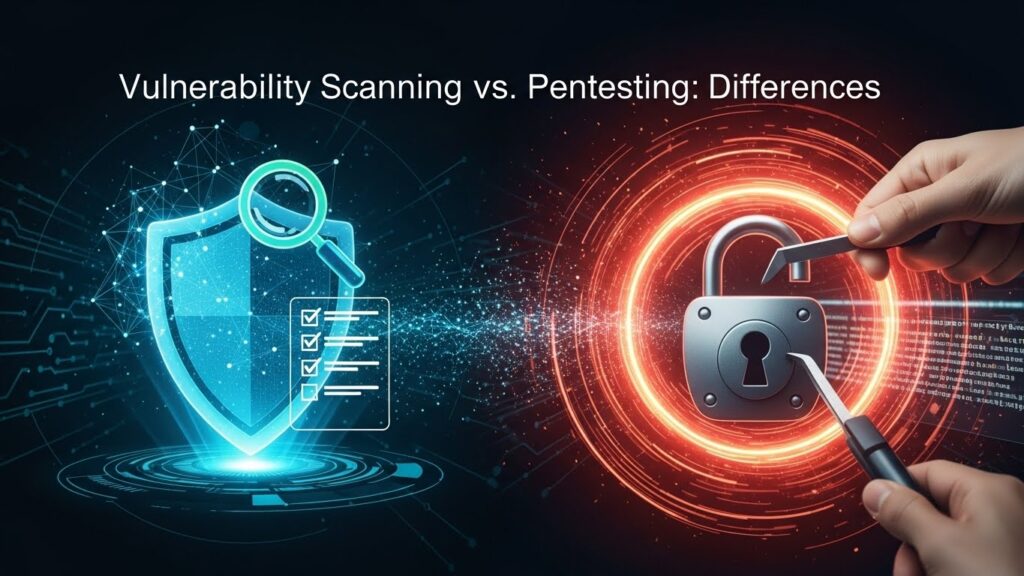
It is the most costly and common mistake in the boardrooms of 2026: believing the company is secure because “the software passed the automatic scan last week.”
There is a dangerous confusion in the industry. Many IT directors equate a Vulnerability Scanning with a real penetration test. However, in cybersecurity terms, this is like confusing checking if the doors are locked (scanning) with hiring an expert to try to pick the lock and enter without being detected (pentesting).
Understanding the real difference between vulnerability scan vs pentest is vital. While one gives you a to-do list, the other tells you exactly how they are going to destroy your business if you do not act.

The Problem: The False Sense of Security
The main pain point here is not technical, it is strategic. Companies invest in automated tools and believe they have “complied.” But modern hackers are not automated scripts; they are creative humans (or advanced AIs) looking for flawed business logic, not just missing patches.
A scan might tell you your server is updated, but it will not detect that your finance employee uses “Password123” or that a misconfiguration allows authentication bypass. Relying only on scanning leaves a “reality gap” that cybercriminals exploit daily.
The Solution: Depth vs. Breadth
To shield your infrastructure, you need both tools, but you must know when to use each one. Here we break down the critical differences.
1. Automation vs. Human Intelligence
Vulnerability Scanning (ASV) is an automated process. It is fast, covers a lot of ground, and is excellent for monthly hygienic maintenance (detecting obsolete software versions). On the other hand, Pentesting is manual and intensive. A human “Ethical Hacker” uses ingenuity, chains minor vulnerabilities to achieve a critical impact, and simulates a real targeted attack. AI cannot replicate the human intuition of a senior pentester.+1
2. Validating False Positives
A scanner will report everything that looks suspicious, often generating “false positives” that waste your team’s time. In a Pentest, the expert validates the vulnerability by exploiting it (in a controlled manner). They do not hand you a list of “possible” problems, but a proof of concept of “confirmed problems” with evidence of exfiltration or unauthorized access.
3. Scope and Frequency
- Scanning: Should be continuous or scheduled (weekly/monthly). It is your constant radar.
- Pentesting: Performed periodically (annual or semi-annual) or after major infrastructure changes. It is your full-scale war simulation.
Conclusion
Do not choose between one or the other; integrate them. Use scanning for daily hygiene and pentesting for deep validation. In 2026, regulations (like PCI DSS 4.0.1) already demand both for a very simple reason: locks are tested by forcing them, not just looking at them.
If you want to know if your company would withstand an attack today, do not ask software. Test your defenses against a human mind.
👉 TEST YOUR SECURITY BEFORE HACKERS DO. SCHEDULE YOUR PENTEST.
🌎 GLOBAL ATTENTION & COVERAGE
📞 Phone / WhatsApp:
- 🇲🇽 MX: +52 1 55 5550 5537
- 🇺🇸 USA: +1 (918) 540-9341
📧 Email Support & Sales:
🌐 Global Coverage & Service Locations We provide immediate attention, strategic consulting, and deployment of Security Compliance Specialists and Cybersecurity Experts across the entire Americas, ensuring business continuity in the main markets of:
- 🇺🇸 United States: Miami, Houston, New York, San Francisco, Los Angeles, among others.
- 🇲🇽 Mexico: Mexico City (CDMX), Monterrey, Guadalajara, Queretaro, Tijuana (Nationwide Coverage).
- 🇬🇹 Guatemala: Guatemala City, Quetzaltenango, Escuintla, Antigua Guatemala (Nationwide Coverage).
- 🌎 Latin America: Bogota, Medellin, Lima, Santiago de Chile, Buenos Aires, Sao Paulo, Panama City, serving the entire region.
Tags: #HackingMode #Cybersecurity #HackingRED #VulnerabilityScan #Pentesting2026